Dr Sharmistha

Fertility Specialist

Can Endometriosis Cause Infertility? Understanding the Connection

Being diagnosed with endometriosis, or perhaps even suspecting that you may have it, will bring up a number of questions in your mind, but one in particular that will definitely be prominent is whether endometriosis causes infertility. This is a legitimate worry, as there are quite a few cases where women are facing this issue and don’t get the right information or help from anyone. But the thing is that endometriosis-induced infertility is not something unknown in medical circles, and, if you consult an expert fertility doctor, you will be able to become pregnant successfully.. What is Endometriosis? Endometriosis is an illness wherein tissues like that lining the uterus are found outside the uterus – most likely growing on the ovaries, fallopian tubes, and the lining tissues of the pelvis. But unlike the uterine lining tissue that sheds itself during the menstrual period, this tissue has nowhere to go once it is shed. Hence, it causes inflammation, scarring, and adhesions (scar tissues that make the organs bind to each other).   There are millions of sufferers of endometriosis all around the world, but many of them remain undiagnosed for several years as the symptoms are usually dismissed as just menstrual pains. Common Symptoms of Endometriosis Periods (dysmenorrhea) that cause severe pain that increases with time Sexual pain Pelvic pain that is not limited to periods Severe period bleeding or bleeding outside of periods Digestion problems like bloating, constipation, or diarrhea, particularly during your periods Fatigue Difficulty becoming pregnant These are some of the signs and symptoms that indicate you may need to see an infertility specialist. So, Can Endometriosis Cause Infertility? Absolutely, because endometriosis is one of the main reasons for women’s infertility. The researches show that there is a certain percentage of women who have trouble with conception, ranging from 30 to 50%. But it should be taken into account that not all women suffering from endometriosis will face the problem of infertility, because it does not necessarily depend on the severity of endometriosis. Let’s see how endometriosis can prevent conception. 1. Distorted Pelvic Anatomy With the growth of endometrium-like tissue and formation of scar tissue, the ovaries, fallopian tubes, and uterus may get displaced. This displacement of organs will make it hard for the egg cell to move from the ovary to the fallopian tube, thus preventing fertilization. 2. Blocked or Damaged Fallopian Tubes In the most severe case, endometriosis will lead to the development of adhesions which will block the fallopian tubes completely, thus preventing the sperm cell from getting to the egg or vice versa. 3. Inflammation Affecting Egg and Sperm Quality Endometriosis can cause chronic inflammation in the pelvic cavity. This inflammation might affect not only the egg and sperm cells but also the embryo itself. 4. Ovarian Reserve Reduction Chocolate cysts, which are also known as endometriomas, are one form of ovarian cysts related to endometriosis. Endometrioma can destroy normal ovarian tissue and decrease the woman’s ovarian reserve, meaning the amount of good quality eggs that can be used in conception. 5. Implantation Issues Although fertilization might happen, endometriosis can make the uterus not receptive enough for the implantation of the embryo. Diagnosing Endometriosis-Related Infertility In case you have been struggling with conception problems and think that you may have endometriosis, meeting an expert in infertility would be your initial move. The diagnostic procedure usually includes:   Detailed medical history and symptom review Pelvic examination Ultrasound imaging to detect cysts or abnormalities Laparoscopy, considered the gold standard for confirming endometriosis, which allows direct visualization and, in many cases, treatment during the same procedure Dr. Sharmistha Sarkar emphasizes the importance of early diagnosis, as timely intervention can significantly improve fertility outcomes for women with endometriosis. Treatment Options for Endometriosis and Infertility The correct treatment depends on the severity of the disorder, the woman’s age, and the duration of her efforts to get pregnant. The following treatment modalities are commonly used: Medication Treatment It helps to control pain and to slow down the progression of endometriosis; however, hormonal therapy is usually avoided while a woman is trying to conceive because most medications affect the ovulation process. Laparoscopy This minimally invasive procedure allows for the removal of endometrial tissue, cysts, and adhesions and increases fertility, especially if endometriosis is mild to moderate. Ovulation Induction Fertility drugs and controlled ovulation may assist in getting pregnant naturally in the case of mild endometriosis. Intrauterine Insemination (IUI) In some cases, intrauterine insemination is indicated along with ovulation induction. In Vitro Fertilization (IVF) If a woman has endometriosis to the extent that she has problems conceiving by other methods, In Vitro Fertilization (IVF) will be the most appropriate method for her. In vitro fertilization will avoid many of the issues that the condition causes in conception.   An experienced fertility specialist will design a personalized treatment program for each woman. Living with Endometriosis While Trying to Conceive However, having endometriosis does not automatically exclude a woman from pregnancy. There are many cases where women with this disease have successfully conceived both naturally and artificially. Here are some pieces of advice that might come in handy when attempting to conceive with endometriosis:   Do not waste time. Seek professional help immediately if you cannot conceive for six months to a year (or even before, if you are older than 35 years). Monitor your symptoms. Your doctor will need to know your experience of pain and the menstrual cycle in order to make the right diagnosis. Try every possible treatment. Whether it is lifestyle adjustment or complex assisted reproductive technologies, there are numerous ways to get pregnant. Look for psychological support. Dealing with fertility problems may be psychologically stressful, and discussing your issues with people who can listen is very important. Why Choose Dr. Sharmistha Sarkar Tackling infertility associated with endometriosis demands a sensitive, experienced, and meticulous method. Being an infertility specialist with extensive experience in dealing with women experiencing fertility problems, Dr. Sharmistha Sarkar is well equipped to provide personalized treatment

Can Endometriosis Cause Infertility? Understanding the Connection Read More »
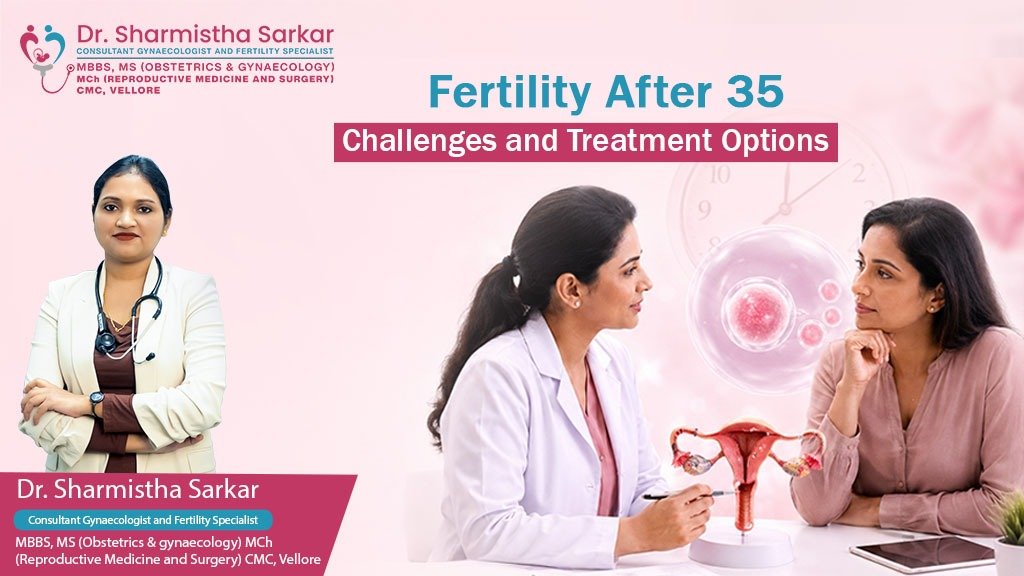
Fertility After 35: Challenges and Treatment Options

Numerous women enter a consultation room and tell their doctor some variation of, “I thought I had more time.” Typically, she is 36, maybe 38, or sometimes 41 – and has realized that having children at her age is not quite as easy as she had hoped.   This confusion is no mystery. The advice that women have received for many years is nebulous, telling women only that “fertility decreases with age.” It does not explain why or what the alternatives are after 35. So let’s discuss it. What Actually Changes After 35 Women are born with all the eggs they’ll ever have – roughly one to two million at birth, down to about 300,000 by puberty. From there, the number keeps dropping every single month, whether or not someone is trying to conceive. By the mid-30s, both the quantity and the quality of the remaining eggs have declined noticeably. This isn’t a guess or a scare tactic; it’s basic reproductive biology, and it’s the reason fertility specialists talk about 35 as a turning point rather than a magic cutoff.   Egg quality matters just as much as quantity. As eggs age, they become more prone to chromosomal abnormalities, which is part of why miscarriage rates climb after 35 and why conditions like Down syndrome become more common in pregnancies conceived at older maternal ages. None of this means pregnancy after 35 is unlikely – it isn’t – but the odds do shift, month by month, in a way they don’t in the late 20s.   There’s also the practical reality that fertility issues aren’t always about eggs alone. Conditions like fibroids, endometriosis, and hormonal imbalances become more common with age too, and they can complicate conception independently of egg quality. Why this Catches so Many Women off Guard So many women were doing everything “right” according to the advice that was given to them – they were focusing on their careers, saving enough money, and finding the right person. All of these things are not wrong. However, the problem with information about fertility timelines is that it is not delivered to women in an honest way, and by the time they start thinking about having children, they have lost years they didn’t realize could be so important.   This is not intended to make women feel guilty, as guilt doesn’t contribute to conception. Instead, this is to help people understand that knowing the biology of the process helps people approach treatment differently. When to See a Specialist It is generally advised that younger women under the age of 35 seek the expertise of a fertility specialist if conception does not occur within 12 months of trying. For women over the age of 35, the window is narrowed to six months. Women over the age of 40 are urged not to wait until then, and an initial consultation once ready for conception can serve to set the benchmark while there is still more time to work with.   These are indications that warrant early consultation, irrespective of age. Testing: What Actually Gets Checked Before jumping to treatment, real information is needed. For women, that typically includes an ovarian reserve assessment – usually AMH (anti-Müllerian hormone) bloodwork paired with an antral follicle count on ultrasound – along with hormone panels and imaging to check the uterus and fallopian tubes. For male partners, a semen analysis is standard, since roughly a third of fertility issues involve male factors and it’s often overlooked early on.   Testing isn’t about assigning blame. It’s about building an accurate map so treatment decisions aren’t a guessing game. Treatment Options After 35 There is no one-size-fits-all treatment plan. It all boils down to the results of your tests, the diagnosis, and what you personally feel comfortable with. Here is a practical example of what usually comes into the equation. Changes to your lifestyle are the very first step taken, not because they cure everything, but because they eliminate certain barriers that are in your hands to control. Losing extra pounds, stress management, less alcohol and cigarettes, treatment for thyroid disorders – all this can make a real difference, sometimes even sufficient in itself. Of course, this will not help you increase the egg reserve, but it is worth starting with. Ovulation induction and IUI (intrauterine insemination) are usually the first medical steps when the fallopian tubes are open and the partner’s sperm count is normal. Medication stimulates egg release, and sperm is placed directly into the uterus around ovulation. It’s less invasive and less expensive than IVF, though success rates drop more steeply with age than they do for younger patients, so this route isn’t usually recommended indefinitely if it isn’t working. In vitro fertilization (IVF) emerges as the more straightforward method for many women who are above 35 years of age, especially those whose ovarian reserve is depleted or if other techniques have not proved effective. Eggs are collected, fertilized in the laboratory, and then one or more embryos are implanted back into the womb. The chances of success for IVF fall with age, but are considerably better compared to those of natural conception at the same age, and that is precisely why it comes up early in the discussion. Preimplantation genetic testing (PGT) is an option that could be incorporated into an IVF treatment cycle to detect chromosomal abnormalities in embryos before their transfer. Although this technique does not enhance the quality of eggs, it may decrease the risk of miscarriage as the embryo which is most viable is selected. Donor eggs become a genuine, and often successful, option when a woman’s own egg reserve or quality has declined significantly. It isn’t the first choice most people imagine for themselves, and it deserves an honest conversation rather than being avoided. For many patients, donor egg IVF offers by far the highest success rates of any option available after 40. Egg freezing, ideally done earlier, is worth mentioning too, since women in their late 30s often

Fertility After 35: Challenges and Treatment Options Read More »

How Obesity Affects Fertility in Women: Everything You Need to Know

You’re eating right, mostly. You’re tracking your cycle down to the day. You’ve read every article the internet has to offer. And still, month after month, nothing.   Sound familiar? Then there’s probably a piece of this puzzle nobody’s mentioned to you yet – not at the dinner table, and sometimes not even in the doctor’s office. Weight. Obesity and fertility in women are far more connected than most people ever get told, and once you see the link, a lot of confusing symptoms suddenly click into place.   Let’s get one thing straight first. This isn’t about blame. It’s not about shame. It’s just biology, doing what biology always does. Fat tissue isn’t some passive layer just sitting there minding its own business. It’s actually working overtime – pumping out hormones, messing with your insulin, constantly chatting with your reproductive system whether you notice it or not. And when that conversation gets a little too loud, fertility is usually the one that pays for it. The Basic Connection Nobody Explains Well Think of fat tissue less like storage and more like an active organ. It produces estrogen. It releases leptin. It sends out inflammatory signals. In normal amounts, this is fine -even necessary. But when body fat climbs significantly, so does this hormone output, and things get noisy.   That extra noise interferes with the very precise signals your brain sends to your ovaries every month. Instead of a clean, predictable cycle, you start seeing delays, skipped periods, or cycles that never quite build up to ovulation at all.   This is really the heart of obesity and fertility in women -it’s not about a number on a scale. It’s about what that number is quietly doing to your internal hormone environment. How Ovulation Gets Thrown Off Track Ovulation is basically a hormone relay race. Estrogen, progesterone, LH, FSH -they all need to hand off to each other at exactly the right moment for an egg to mature and release.   Extra fat tissue produces additional estrogen on top of what your ovaries are already making. Your brain sees this and essentially thinks, “hormones are already high enough, no need to trigger ovulation.” So it doesn’t. Cycles get longer. Some months, ovulation doesn’t happen at all.   If you’ve noticed your periods getting unpredictable, this is often the first visible sign of obesity and female fertility issues -long before anyone starts actively trying to conceive. The Insulin Piece Most People Miss Here’s something that rarely comes up in casual conversation: obesity is closely tied to insulin resistance. Your cells stop responding to insulin the way they should, so your pancreas compensates by pumping out more of it.   That excess insulin pushes your ovaries to produce more androgens -yes, the same hormones associated with male characteristics. This throws off follicle development and, again, disrupts ovulation.   This is also a big reason obesity and PCOS show up together so often. And PCOS, on its own, is one of the most common causes of infertility today. The good news is that managing insulin -through food choices, movement, sometimes medication -tends to improve ovulation fairly reliably. Why Your Doctor Keeps Bringing Up BMI If your doctor keeps circling back to your BMI during fertility conversations, it’s not a throwaway comment. There’s real research behind it. BMI and fertility outcomes are linked pretty consistently across studies.   Higher BMI tends to show up alongside: A longer stretch of time trying to conceive naturally Lower success rates with treatments like IUI and IVF A higher chance of miscarriage after conception More pregnancy complications down the line None of this means a higher BMI equals infertility -plenty of women with higher BMI conceive naturally and have completely healthy pregnancies. But statistically, the odds shift a bit, and it’s better to know that early than to find out the hard way. It Doesn’t Stop at the Positive Pregnancy Test Something that gets overlooked constantly: overweight and fertility struggles don’t end the moment you conceive. They can follow you right through the pregnancy.   Higher body weight during pregnancy is linked to a higher chance of gestational diabetes, high blood pressure, needing a C-section, and complications during delivery. So the real question isn’t just “can I get pregnant.” It’s also “how smoothly will this pregnancy go once I am?” Does Weight Actually Affect Fertility Treatment Success? It does, and this surprises a lot of people. Women with higher BMI often see somewhat lower success rates with IVF and IUI. Part of this comes down to egg quality. Part of it comes down to how the body responds to fertility medications -sometimes needing higher doses to get the same effect. And part of it involves the uterine lining and how well an embryo can implant.   Because of this, a lot of fertility clinics now build weight management directly into the treatment plan instead of treating it as a side note. A fertility specialist will often suggest addressing weight before diving into treatment cycles, simply because it tends to improve the odds. Here’s the Genuinely Good News This isn’t a life sentence. Research shows that losing even five to ten percent of body weight can meaningfully improve ovulation and rebalance hormones for a lot of women. That’s a realistic target -not a total life overhaul.   Plenty of women see their cycles regulated again within a few months of steady, sustainable changes. This is exactly why doctors push back against crash diets and extreme restrictions. Those approaches often backfire, adding stress to the body that makes hormonal imbalances worse, not better. What Actually Helps You don’t need to overhaul everything overnight. Small, consistent habits tend to move the needle more than dramatic short-term changes.   Eating balanced meals with enough protein, fiber, and healthy fats -instead of chasing the latest restrictive diet trend -matters more than most people expect. So does simply moving your body regularly; something as basic as a daily walk can improve insulin sensitivity

How Obesity Affects Fertility in Women: Everything You Need to Know Read More »

The Real Truth About Infertility: A Letter From Dr. Sharmistha Sarkar

If you’re reading this right now, there’s a good chance you’re doing it alone. Or maybe your partner is sitting beside you, but you both feel miles apart. Maybe you’re at work, pretending everything is fine, while inside you’re breaking. Maybe you just saw another pregnancy announcement and had to excuse yourself. I’ve been a fertility specialist for years, and I’ve learned something that most medical textbooks don’t teach: infertility isn’t just about biology. It’s about the silence. It’s about shame. It’s about lying awake at 3 AM wondering if something is fundamentally wrong with you. I’m writing this because I want you to know something before you even come to see me: You are not broken. You are not alone. And what you’re feeling is real—it’s valid, and it matters. The Truth Nobody Tells You Let me be honest with you from the start. One in six couples globally struggle with infertility. That’s millions of people. But infertility is still treated like a secret—whispered about in private, hidden from friends and family. Women carry this shame alone while their bodies become a source of grief instead of joy   Here’s what I see in my clinic every single day: intelligent, accomplished, beautiful women who have somehow internalized the belief that they’ve failed. That there’s something fundamentally defective about them. Men who feel emasculated and confused. Couples who used to laugh together and now can barely look each other in the eye   The emotional weight is real. Research shows that women experiencing infertility report anxiety and depression levels comparable to cancer patients. Not because infertility is life-threatening, but because it attacks something primal—your dreams, your identity, your vision of your future family   And here’s the heartbreaking part: 48% of couples avoid seeking help because they can’t face a formal diagnosis. They’d rather suffer in silence than admit something is wrong.   If that’s you—I’m asking you to pause that thinking right now. Please. What Changed When I Started Listening I remember the exact moment everything shifted in my practice. A couple came in after their third failed IVF cycle. The woman was hollow-eyed and broken. Her husband sat silently, disconnected. I started with the science, the data, and the next protocol. And she cried and said, “I don’t need to know about percentages. I need to know that you believe in us. I need to know this isn’t hopeless.” That changed me. I realized that every patient walking into my clinic wasn’t asking for complicated medical jargon. They were asking for something deeper: hope wrapped in truth, delivered with compassion. So I stopped treating infertility as purely a medical problem. I started treating couples as whole human beings experiencing a life crisis. I started listening more than I talked. And—this matters—I started explaining everything in simple language because you shouldn’t need a medical degree to understand your own treatment. Here’s What I Actually See When You Come In When you walk through my door, I don’t see you as a “case” or a “protocol.” I see a person who’s been carrying this alone. I see your courage in finally seeking help. I see someone who deserves clarity, honesty, and a plan designed specifically for you—not a generic package.   The first thing we do is listen. We will talk about your story. When did this start? How long have you been hoping? What’s the hardest part of this journey for you? What matters most to you in treatment?   Then we do the tests. These aren’t meant to shame you or label you. They’re detective work. They’re us trying to answer the question: What is actually preventing your body from doing something it’s designed to do? Once we know the answer, everything else becomes clear. The Three Pathways—And Why One Size DOESN’T Fit All Here’s where most fertility practices get it wrong: They have a protocol, and they plug you into it. IVF for everyone. Because it has the highest success rates, so obviously it’s best, right? No. That’s not medicine. That’s laziness. Real medicine means understanding your specific situation and choosing the gentlest, most effective path for you. Pathway 1: When We Start Gentle (PCOS, Hormonal Imbalance, Mild Issues) Some of you need medication. Maybe your cycles are irregular, or your hormones are out of balance. In recent years, something remarkable happened: we discovered a combination of Metformin + Myo-Inositol that actually works brilliantly for PCOS. Not expensive. Not invasive. Just smart medicine.   I had a patient, Priya, who was diagnosed with PCOS. She came to me expecting to jump straight to IVF, fearing it would cost ₹2-3 lakhs. Instead, we started her on this combination therapy for about ₹4,000 a month. After three months, her cycles regulated. After six months, she was pregnant naturally. Total cost: ₹32,000. Total time: seven months. She avoided ₹3,00,000 in IVF costs and the emotional intensity of high-tech treatments   If you’re under 35 with regular-ish cycles and clear tubes, we often start with IUI (intrauterine insemination). It’s like nature’s version, but we help it along. Success rates are 10-25% per cycle—and when you do the math across multiple cycles, many couples get pregnant this way.   The point: We escalate only when necessary, not because it’s profitable. Pathway 2: When We Need Structure (Blocked Tubes, Severe Male Factor) Some of you have structural problems we can’t work around. If both your fallopian tubes are blocked, no amount of medication will help—the egg and sperm will never meet. In that case, IVF isn’t an option. It’s the only logical choice. Similarly, if a partner’s sperm count is extremely low, or the sperm aren’t moving properly, trying IUI is like asking someone to climb a mountain without ropes. We use ICSI—a specialized IVF technique where we inject a single sperm directly into the egg. Fertilization rates go from 10% to 70-80%. That’s not up-selling. That’s using the right tool for the job.   IVF success rates for women under 35

The Real Truth About Infertility: A Letter From Dr. Sharmistha Sarkar Read More »