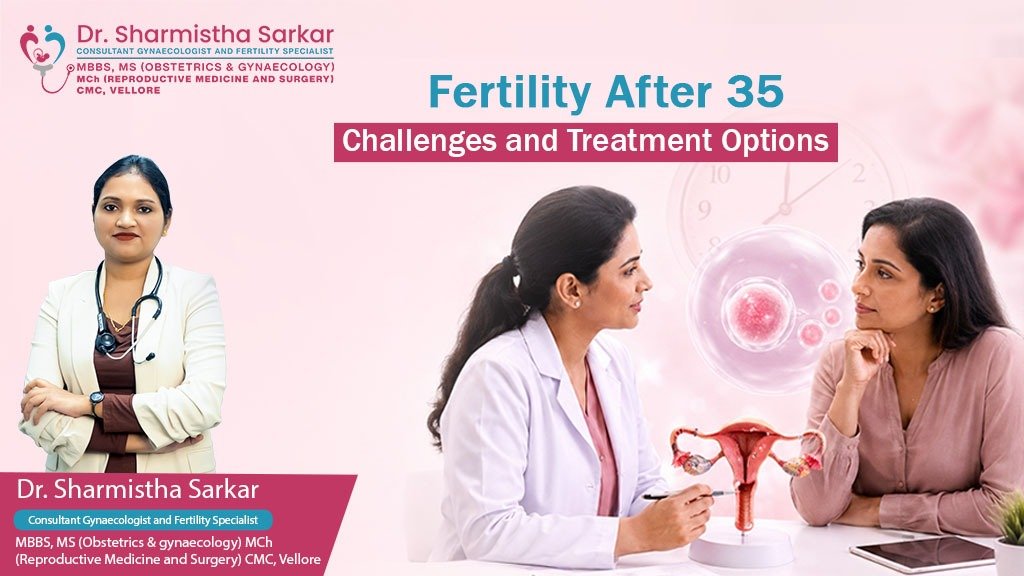
Numerous women enter a consultation room and tell their doctor some variation of, “I thought I had more time.” Typically, she is 36, maybe 38, or sometimes 41 – and has realized that having children at her age is not quite as easy as she had hoped.
This confusion is no mystery. The advice that women have received for many years is nebulous, telling women only that “fertility decreases with age.” It does not explain why or what the alternatives are after 35. So let’s discuss it.
What Actually Changes After 35
Women are born with all the eggs they’ll ever have – roughly one to two million at birth, down to about 300,000 by puberty. From there, the number keeps dropping every single month, whether or not someone is trying to conceive. By the mid-30s, both the quantity and the quality of the remaining eggs have declined noticeably. This isn’t a guess or a scare tactic; it’s basic reproductive biology, and it’s the reason fertility specialists talk about 35 as a turning point rather than a magic cutoff.
Egg quality matters just as much as quantity. As eggs age, they become more prone to chromosomal abnormalities, which is part of why miscarriage rates climb after 35 and why conditions like Down syndrome become more common in pregnancies conceived at older maternal ages. None of this means pregnancy after 35 is unlikely – it isn’t – but the odds do shift, month by month, in a way they don’t in the late 20s.
There’s also the practical reality that fertility issues aren’t always about eggs alone. Conditions like fibroids, endometriosis, and hormonal imbalances become more common with age too, and they can complicate conception independently of egg quality.
Why this Catches so Many Women off Guard
So many women were doing everything “right” according to the advice that was given to them – they were focusing on their careers, saving enough money, and finding the right person. All of these things are not wrong. However, the problem with information about fertility timelines is that it is not delivered to women in an honest way, and by the time they start thinking about having children, they have lost years they didn’t realize could be so important.
This is not intended to make women feel guilty, as guilt doesn’t contribute to conception. Instead, this is to help people understand that knowing the biology of the process helps people approach treatment differently.
When to See a Specialist
It is generally advised that younger women under the age of 35 seek the expertise of a fertility specialist if conception does not occur within 12 months of trying. For women over the age of 35, the window is narrowed to six months. Women over the age of 40 are urged not to wait until then, and an initial consultation once ready for conception can serve to set the benchmark while there is still more time to work with.
These are indications that warrant early consultation, irrespective of age.
Testing: What Actually Gets Checked
Before jumping to treatment, real information is needed. For women, that typically includes an ovarian reserve assessment – usually AMH (anti-Müllerian hormone) bloodwork paired with an antral follicle count on ultrasound – along with hormone panels and imaging to check the uterus and fallopian tubes. For male partners, a semen analysis is standard, since roughly a third of fertility issues involve male factors and it’s often overlooked early on.
Testing isn’t about assigning blame. It’s about building an accurate map so treatment decisions aren’t a guessing game.
Treatment Options After 35
There is no one-size-fits-all treatment plan. It all boils down to the results of your tests, the diagnosis, and what you personally feel comfortable with. Here is a practical example of what usually comes into the equation.
Changes to your lifestyle are the very first step taken, not because they cure everything, but because they eliminate certain barriers that are in your hands to control. Losing extra pounds, stress management, less alcohol and cigarettes, treatment for thyroid disorders – all this can make a real difference, sometimes even sufficient in itself. Of course, this will not help you increase the egg reserve, but it is worth starting with.
Ovulation induction and IUI (intrauterine insemination) are usually the first medical steps when the fallopian tubes are open and the partner’s sperm count is normal. Medication stimulates egg release, and sperm is placed directly into the uterus around ovulation. It’s less invasive and less expensive than IVF, though success rates drop more steeply with age than they do for younger patients, so this route isn’t usually recommended indefinitely if it isn’t working.
In vitro fertilization (IVF) emerges as the more straightforward method for many women who are above 35 years of age, especially those whose ovarian reserve is depleted or if other techniques have not proved effective. Eggs are collected, fertilized in the laboratory, and then one or more embryos are implanted back into the womb. The chances of success for IVF fall with age, but are considerably better compared to those of natural conception at the same age, and that is precisely why it comes up early in the discussion.
Preimplantation genetic testing (PGT) is an option that could be incorporated into an IVF treatment cycle to detect chromosomal abnormalities in embryos before their transfer. Although this technique does not enhance the quality of eggs, it may decrease the risk of miscarriage as the embryo which is most viable is selected.
Donor eggs become a genuine, and often successful, option when a woman’s own egg reserve or quality has declined significantly. It isn’t the first choice most people imagine for themselves, and it deserves an honest conversation rather than being avoided. For many patients, donor egg IVF offers by far the highest success rates of any option available after 40.
Egg freezing, ideally done earlier, is worth mentioning too, since women in their late 30s often ask whether it’s “too late.” It isn’t necessarily too late – but success rates depend heavily on how many eggs are retrieved and their quality at the time of freezing, both of which favor doing this sooner rather than later for anyone considering it for future use.
The Bottom Line
Thirty-five isn’t a wall. It’s a point where the math starts working against a person a little more each year, and where getting real information sooner rather than later genuinely matters. Some women conceive naturally at 38 without any intervention. Others need IVF at 33 because of conditions that have nothing to do with age. There’s no universal timeline, only an individual one.
Anyone trying to conceive after 35, or thinking about it, doesn’t need to wait a full year of trying before asking questions. Getting ovarian reserve checked early, understanding where things stand, and making decisions from there is usually the better path. Time matters in this conversation, but so does having accurate information instead of anxiety in the driver’s seat.
To discuss your specific situation, book a consultation with Dr. Sharmistha Sarkar to go over your fertility health and the options that make sense for you.