
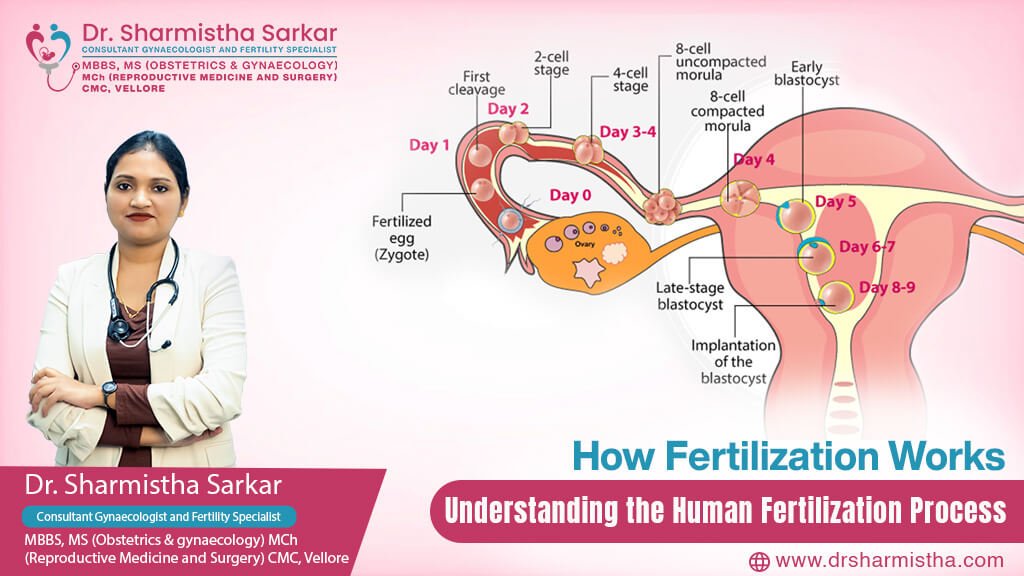
How Fertilization Works: Understanding the Human Fertilization Process
Life Begins With One Extraordinary Moment. There is something miraculous that occurs in the human body – in a pocket no bigger than a finger. One sperm cell and one egg fuse. And from that one meeting, a new life springs. The Act of Fertilization is one of the most wonderful in all biology. It is precise. It is complex. For many people who desire to build a family, comprehension can make a world of difference. Whether you are trying to conceive naturally or exploring options like IVF, knowing how fertilization works puts you in a much stronger position. What is the Process of Fertilization? Fertilization is the successful entry of a sperm cell and the bringing together with an egg cell. If all goes well, the result is a fertilized egg called a zygote. The zygote develops into an embryo. That baby is formed into an embryo. However, the road to this is far from easy. Step by Step: The Human Fertilization Process Fertilization starts with a race. Millions of sperm make the journey. Only one wins. That single sperm breaks through the egg’s outer layer -and the moment it does, the egg locks itself shut. No others get in. Step 1 -Ovulation It all starts with ovulation. Every month, one of the ovaries will mature an egg to be released. This egg will pass the fallopian tube – it only has a narrow window of opportunity. Eggs are only fertile for 12-24 hours after they are laid. That window is all that. Step 2 – The Sperm’s Journey Begins In the 2nd step, the sperm starts its journey. The 2nd step is the beginning of the sperm’s journey. In sexual intercourse, millions of sperm are shed. Only part of it will come close to the egg. It is a long and arduous trip. The sperm travel through the cervix, through the uterus, and into the Fallopian tubes. As they go along, the numbers take a dramatic plunge. Only a few hundred get to the egg out of millions that begin. Only one gets in. Step 3 -Sperm Meets Egg Once the sperm is successful in reaching the egg, it is not just a slide in the door. It has to break through two protective layers -the corona radiata and the zona pellucida that surround the egg. This is broken down by multiple sperm. Only one sperm makes it into the entry. At the moment that the first sperm enters the egg, an outer coating immediately modifies to exclude all of the others. Nature’s way of guaranteeing that only one egg is fertilized by sperm. Step 4 -Fertilization Happens Upon entering, the genetic material of the sperm is dropped. The payment presented in the cross 23 chromosomes from papas and 23 chromosomes from moms merge and will create the 46 chromosomes for a baby. Put together these form 46 -one full, unique set of DNA of human origin. A new cell is formed. It is known as a zygote. Only fertilization occurs at this time. Here is where life starts. The Zygote begins to divide in the next stage of the procedure. Step 5- The zygote starts dividing Within hours, it starts to divide. Each cell gives birth to itself, making two become four, four become eight. This is known as the cleavage process. This development of cells begins to move slowly over the next few days and is called the morula. The morula is the beginning of the growth of cells, which slowly move down the fallopian tube for the next 3-4 days. Step 6 -The Blastocyst Forms By day five or six, the cluster of cells has become a blastocyst -a more developed structure with a fluid-filled centre and an outer layer of cells. This is the stage that matters for IVF. When embryos are transferred during IVF treatment, they are usually at the blastocyst stage, because it gives the best chance of successful implantation. Step 7 -Implantation The blastocyst reaches the uterus and searches for a place to attach. When it finds the right spot in the uterine lining, it burrows in. This is called implantation. It usually happens around 6 to 10 days after fertilization. Once implantation is successful, the body starts producing hCG-the hormone detected by a pregnancy test. This is the moment pregnancy officially begins. What Can Go Wrong? The fertilization process is accurate. There is a lot of room for things to go amiss, and precision involves so many points at which trouble can be encountered. It may fail to release the egg because of hormonal imbalance or other factors, such as PCOS. Sperm may not find its way to the egg: there could be a low number of sperm, or the motility is poor, or the sperm encounter blockages. Fertilization may not happen -when sperm and egg merge, the melding doesn’t always take place. Didn’t attach the embryo -even a healthy embryo sometimes does not attach to the uterine wall Early miscarriage -sometimes implantation occurs, but the pregnancy does not continue All of these things could get in the way of a couple being able to conceive. The positive is that some do have a way of identification, and many can be treated. What Does Fertilization Look Like in IVF? For most of human history, fertilization happened in one place – inside the body, quietly, invisibly. Nobody could watch it. Nobody could guide it. IVF changed that entirely. In vitro fertilization allows the moment of fertilization to happen in a controlled lab environment, under the careful watch of trained embryologists. It sounds clinical. In reality, it’s quite extraordinary. There are two main ways fertilization happens in IVF. The method your doctor recommends depends on your specific situation – and both have helped millions of people become parents. Method 1: Conventional IVF (Insemination) In conventional IVF, the egg and sperm are
How Fertilization Works: Understanding the Human Fertilization Process Read More »